
Object Record
Images
Metadata
Artist |
Cajero, Michael |
Title |
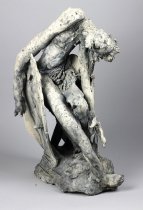
Stroke Victim |
Date |
2002 |
Medium |
stoneware |
Culture |
American |
School |
Tucson Artist |
Object ID |
2004.8.2 |
Collection |
Contemporary Latin American Art |
Object Name |
Sculpture |
Credit line |
Gift of Inge Meyer |
Didactic Information |
Tucson artist Michael Cajero creates figurative compositions that reveal the drama and expressiveness of the realities of the human condition. Working in ceramics as well as pâpier maché, Cajero is interested in the 1960s and 1970s Process movement, which stressed the physicality of materials, and Arte Povera, which made use of raw forms and common materials. Cajero's ceramic works show a heightened sense of emotion or pathos due to his expressive manner of working in clay. In Stroke Victim, Cajero expresses the agony and physicality of a distressed body. Confined to a wheelchair, the contorted man turns his head to the side to reveal an expression that appears like rage and defiance about his condition. In Shoeshine, both the customer and the service provider are rendered in rough textures, hues, and form. As if on a throne, the man receiving the shoe shine is made larger than the man (a "shoe shine boy") who bends over like a supplicant to provide his service. The disparity of scale speaks volumes about master/servant dichotomy and the power of money to diminish and demoralize what is often called the "lower class." [[Paired with Shoeshine, 2004.8.1]] (Feb 2017). Michael Cajero is a Tucson artist who creates figurative compositions in low- and high-fired ceramics and also in papier-mâché, incorporating such materials as cardboard, paint, shredded paper, and metal rebar. Cajero's current work focuses on materials raided from trash heaps at import stores. Cajero is interested in the Process art movement from the mid-1960s to the early 1970s, which stressed the physicality of materials, and Arte Povera from the same period, which focused on the use of raw forms and everyday materials. The materials, which are often thrown together, pressed and torn, slashed and splashed, enhance the drama of his figures and often times are then burned. As the artist explains, "I use these transitory, ephemeral materials in my figure sculpture to emphasize the impermanence and vulnerability of existence." Cajero's ceramic works also reveal heightened sense of emotion or pathos because of the expressive manner in which he works. His ceramic sculptures glazed with experimental glazes, which vary from light washes that resemble metal patinas to heavily encrusted surfaces, are similar to the early works of noted ceramic artist Ken Price. |